The heaviest fabric here, and a size chart that skips 21 inches
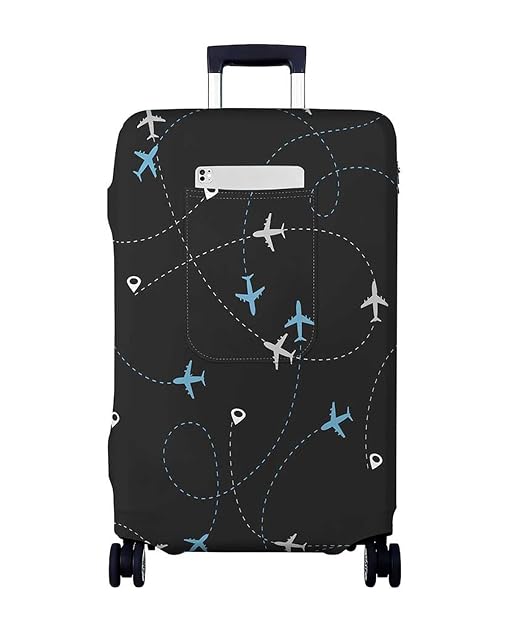
WUJIAONIAO CLLG001 stretch cover, 18–32 in
The thickest material on this shelf by a clear margin — on the only size chart in this hub that leaves an inch unaccounted for.
Three hundred and twenty grams per square meter is the most fabric anyone on this shelf is offering, against 300 from two covers and 250 from a third, and the listing is right about what that buys: abrasion resistance. A cover is dragged over belts, stacked under heavier bags and thrown into holds, and weight per square meter is the figure that decides how many trips it survives. With 15 per cent spandex it also has the stretch of the better covers here, and it zips on both sides, so a case with its grab handle on the left is as well served as one on the right.
Then there is the chart. S is stated for 18 to 20 in and M for 22 to 24, which leaves 21 in belonging to neither — the only gap in any size chart in this hub, and it falls inside the cabin range. Three other covers on this shelf run their small size to 22 in. The introduction to this page explains what happens when the answer is to force the smaller one on: a cover stretched too tight tears at the seams within a few trips.
The other thing worth holding up is the fitting advice, because the cover further down this shelf gives the opposite. This page says to order a bigger size for a soft shell. Explore Land says to order a bigger size for a hard shell, or for a case with an expansion zip. Both are 15 per cent spandex over polyester, both are sold by the same four size bands, and there is a reasonable argument behind each — a soft case bulges as it is packed, a hard case has unyielding corners. Neither page gives you anything to decide with. As for the rest, the material is described as “Super high laminating, highly elastic, shaped like yoga tenacity”, and there is no window or tag cut-out, which puts it with every other listing on this shelf.
Availability
Read on the day this page was built: $14 at the American Amazon shop.
Read from Keepa on the day this page was last revised; stock and price both move without notice.
Prices quoted in this text were read on 2026-10-07. The live price is at the top of the page.
What travelers ask
What does 320 grams of fabric actually buy?
Abrasion resistance, which is what a cover is mostly for. A cover spends its life being dragged across belts and stacked under other bags, and the weight per square meter is the figure that decides how many trips it survives — this is 320 g (11.3 oz) against 300, 300 and 250 for the rest of this shelf, with the same 15 per cent spandex as two of them. The listing says as much in its own words, that the thickness is there to increase abrasion resistance. It is the one measurable claim on the page.
What happens if my case is 21 inches?
Nothing good, by this chart. S is stated for 18 to 20 in and M for 22 to 24, which leaves 21 in between two sizes — and 21 in is squarely in the cabin range. Every other chart on this shelf covers it: three put the boundary at 22 and 23, and one at 22. A stretch cover will often take a case an inch over its stated top, which is precisely the failure the introduction to this page describes — a cover stretched too tight tears at the seams within a few trips.
Hard shell or soft shell — which needs the bigger size?
The two covers on this shelf disagree, and they are built the same way. This listing says "If your luggage is soft shell style, please order a bigger size." The Explore Land cover further down says "If your luggage is hard shell style or extended space, please order a bigger size." Both are 15 per cent spandex over polyester, both sold by the same size bands, and they give opposite instructions. There is an argument for each — a soft case bulges when packed, a hard case has no give at the corners — and no way to settle it from either page.