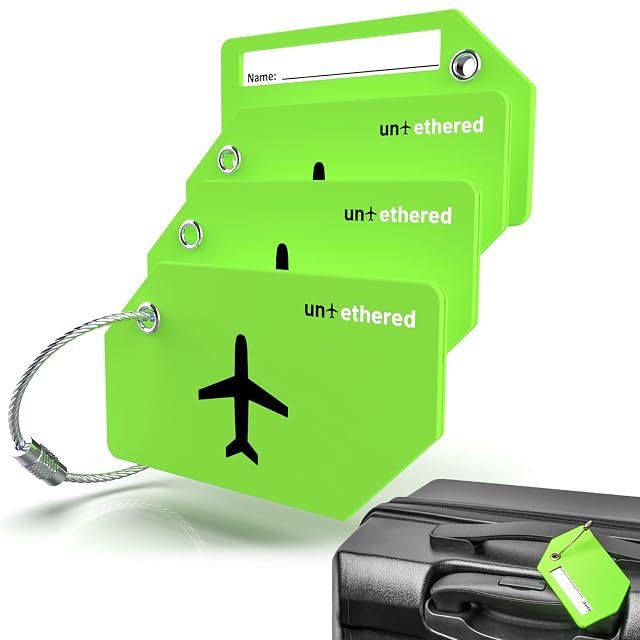
The only tag here to name the grommet — where a tag actually tears
Untethered Silicone tags, 4-pack
The only listing in this hub to specify the reinforced metal eyelet the loop passes through, which is the part that fails.
There is one part on a luggage tag that actually breaks, and only one listing in this hub names it. Not the loop, which is steel, and not usually the strap — what fails is the tag tearing around its own hole when something catches it on a conveyor. This listing publishes a reinforced all-metal grommet set into that hole, with a stainless steel luggage loop through it, which spreads the load into a metal ring instead of concentrating it on a few millimeters of silicone. The introduction to this page says attachment durability is the first specification worth checking; this is the only page on the shelf that checks it at the right place.
The second good decision is the shape, and it addresses the same failure from the other end: a uniquely shaped 3.5 by 2 inch tag designed to reduce snags so it does not catch in the first place. Two other tags here reach for the same idea with rounded card edges and a compact footprint.
The cover is partial and the listing says so, which puts it among the honest minority. It reveals the name only, and it explains the reasoning: a bag that is lost can still be identified, while the address and phone number stay hidden. Of the nine tags on this shelf, four claim a full cover, three describe a partial one, and two have none. A full cover is better privacy and slower recovery; a partial one is a deliberate compromise rather than a failure of the flap.
What is left out is the paper. There is no insert size, nothing about whether a card is supplied, and nothing about how the name is written — which on a tag whose cover is designed around showing the name is an odd gap. The pack is four tags in one color, so they will find your bags among other people’s and not among each other’s, and the first two bullets are spent on the convenience of owning four of something.
Availability
Read on the day this page was built: $10 at the American Amazon shop.
Read from Keepa on the day this page was last revised; stock and price both move without notice.
Prices quoted in this text were read on 2026-10-07. The live price is at the top of the page.
What travelers ask
What is a grommet and why does it matter?
It is the reinforced metal eyelet set into the tag, through which the loop passes. It matters because that hole is where a luggage tag fails: the loop almost never breaks, and the strap rarely does — what happens is that the tag tears around its own hole when something catches it on a belt. A metal grommet spreads that load into a ring instead of concentrating it on a few millimeters of silicone. The introduction to this page calls attachment durability the first specification to check, and of the nine tags in the American half of this hub, this is the only listing that names the part the failure actually occurs at.
Is a partial cover better or worse than a full one?
It is a different choice, and this listing is the clearest on the shelf about why it made it: the cover reveals the name only, so the bag can still be identified if it is lost while the address and phone number stay hidden. A full cover is better privacy and slower recovery, because somebody has to lift the flap to learn whose bag it is. Three tags here are partial, four are full, and two have no cover at all. Which you want depends on whether you are more worried about the carousel or the lost-property office.
What is the shape for?
Not snagging. The listing says the uniquely shaped 3.5 by 2 inch design reduces snags and keeps the tag from catching on things in transit — which is the same problem the grommet addresses from the other end. One tag on this shelf gives rounded card edges for the same reason and another cites its compact size. A tag torn off a handle takes your information with it, so a shape that does not catch and an eyelet that does not tear are the two halves of one answer.