Four graduated compression cubes, and a mesh counted by the hole
Veken PCC3V115, 9-piece compression set
Real compression across four graduated sizes, with each size matched to what goes in it — on a title that advertises the number of holes in its mesh.
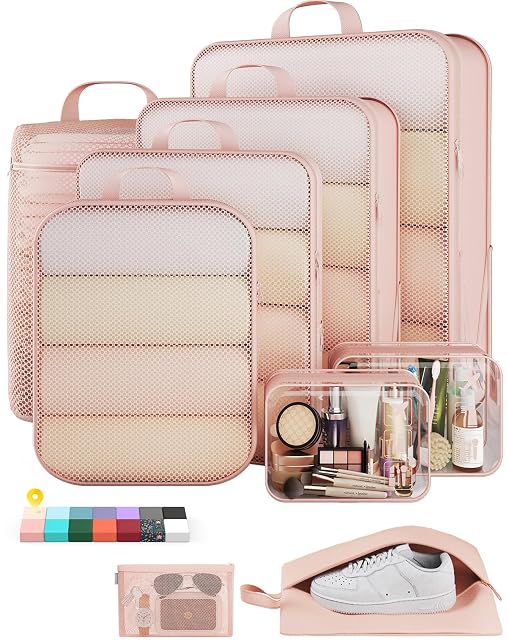
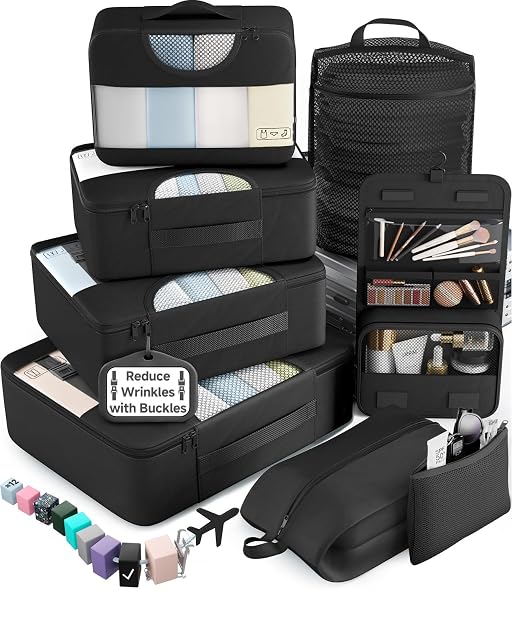
This is one of the two sets in the American half of this hub with a real second zip, and it is the better organized of them. Four graduated compression cubes, S through XL, each zipped closed and then compressed with a separate track and no tool — and, unusually, the listing says what each size is for: underwear and socks in the small, shirts in the medium, jeans and light sweaters in the large, coats and bulky items in the extra large. That is the difference a graduated set makes over four identical cubes, which is that it fills the corners of a case rather than filling it in layers. Around them come two wash bags, a laundry bag, a shoe bag and a pouch, and the page states the case sizes it is built for, 20 to 34 in.
What it does not do is tell you how much the compression achieves. The set below this one on the shelf publishes a before and after — four inches of thickness down to one — and this page says only that the zips reduce volume. On a product whose whole premium over a mesh set is the second zip, the number is the specification, and its absence leaves this shelf’s buying tip half answered: the mechanism is confirmed, the result is not.
The title is where the page spends its precision instead: “Over 1000 pcs of Mesh Holes”. Counting the apertures in a netting is a number that cannot be used — breathability is a matter of open area and weave, and a finer mesh has more holes and smaller ones, so a bigger count can mean less air. The other gap is the one this shelf shares: no dimension for S, M, L or XL, which leaves four size names where the introduction to this page asks for sizes that nest predictably.
Availability
Read on the day this page was built: $30 at the American Amazon shop.
Read from Keepa on the day this page was last revised; stock and price both move without notice.
Prices quoted in this text were read on 2026-10-07. The live price is at the top of the page.
What travelers ask
Is the compression real here?
Yes. The bullet describes zipping the compression zippers to reduce volume with no extra tools, which is the mechanism this shelf's buying tip asks you to confirm: a second zip track that pulls the panel down after the first has closed the cube. Of the nine sets in the American half of this hub, four have it and all four say "compression" in the title — so on this shelf the word is used accurately. What is missing is the figure. The set below this one publishes a before and after thickness; this one publishes the feature and not the result.
What do graduated sizes get you that four identical cubes do not?
Corners. The introduction to this page compares whether a set's sizes nest predictably, and a graduated S, M, L and XL fills the awkward spaces a case has — an XL for a coat along the back, an S for socks in the gap by the wheels — where four cubes of one size fill a case in layers. This listing goes further than its shelfmates by naming what each size is for: underwear and socks, T-shirts and shirts, jeans and light sweaters, coats and bulky items. What it does not do, and nothing on this shelf but one listing does, is publish a dimension for any of them.
What is a mesh hole count?
A number in a title rather than a specification. "Over 1000 pcs of Mesh Holes" counts the apertures in the netting, and the quantity tells you nothing a buyer can use: breathability depends on the open area and the weave, not on how many holes it has been divided into, and a finer mesh has more holes and smaller ones. The useful figure for mesh on this shelf is the tension it carries, which one other listing offers — incompletely — and this one does not.