Colored lines so you can see the zip is actually sealed
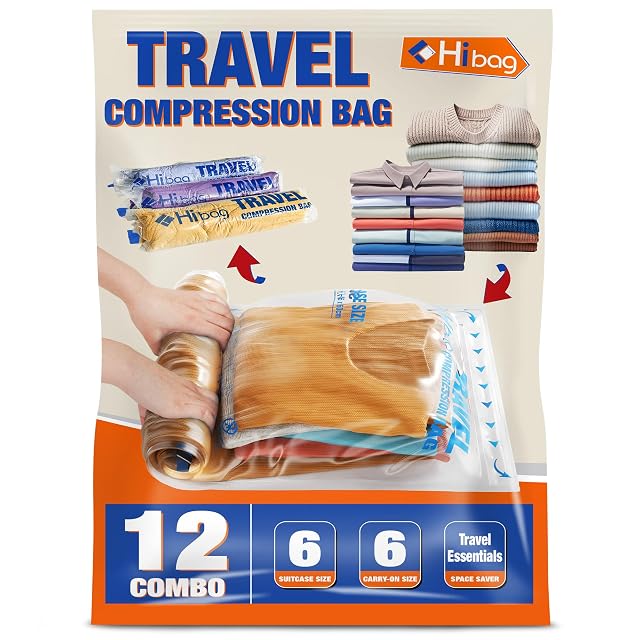
HIBAG 12-Travel roll-up compression bags
The cheapest set in this hub, and the only one that puts colored lines on the zip so you can see whether the seal has closed.
This is the cheapest thing in this hub and the one detail it publishes is a good one. Two colored lines, yellow and blue, run along either side of the zip, so you can see whether the double track has actually engaged along its whole length — which matters because that is how these bags fail. A zip that looks shut with one track open lets the air back in while you sleep, and you find out when the flat bag has become a pillow. The two-level zip, one side lower than the other, is there for the opposite job: separating the tracks to open the bag without a fight.
The mechanism is the reason to buy it. There is no pump, no power and nothing to charge: you close the zip, roll the bag from the top down, and the air goes out. That works in a hostel at midnight exactly as it works at home, which is the whole of the advice at the top of this page — five of the seven sets on this shelf come with a cordless pump, and a pump is a thing to carry, charge and not leave behind.
The claim is up to 80 per cent, which is the joint highest figure on this shelf and sits oddly beside the introduction to this page, which says a vacuum-valve bag compresses further. Both are defensible: a pump pulling against a sealed bag beats a forearm on a roll, and the percentages on both sides are maxima rather than measurements. What is fair to say is that this bag gets most of the air out wherever you are.
What the page does not do is publish anything. Six medium, six large, and no dimension for either — where the roll set beside it on this shelf gives 20 by 16 and 24 by 16 inches, and all five pump sets publish three sizes. No material is named, where four sets here state PA+PE. The mechanism is never described: no valve, no clip, no rolling instruction. And the title says “No Vacuum Needed” above a fourth bullet headed “Vacuum Packing Bags”.
Availability
Read on the day this page was built: $10 at the American Amazon shop.
Read from Keepa on the day this page was last revised; stock and price both move without notice.
Prices quoted in this text were read on 2026-10-07. The live price is at the top of the page.
What travelers ask
Why do the colored zip lines matter?
Because the failure of these bags is almost always the zip. A double-track zip that looks closed but has one track open lets air back in overnight, and you discover it when the bag is a pillow again in the morning. Yellow and blue lines on each side give you something to look at: when the colors meet along the whole length, the tracks are engaged. The two-level design — one side set lower than the other — exists for the opposite problem, separating the tracks to open the bag. Of the seven sets in the American half of this hub, this is the only one to publish either idea.
Does a roll bag really save as much as a vacuum bag?
The listings on this shelf say yes and the physics says no, and both halves of that deserve stating. This bag claims up to 80 per cent, which is the joint highest figure on this shelf — equalled by two pump sets and above the 70 per cent claimed by two others. The introduction to this page says a vacuum-valve bag compresses further, which is true of a pump pulling against a sealed bag rather than a forearm pressing a roll. What that means in practice is that both figures are marketing maxima: the honest comparison is that a roll bag gets most of the air out anywhere, and a pump gets more of it out where the pump is.
What is missing from the page?
The sizes, and the mechanism. Six medium and six large, with no dimension in inches or centimeters for either — where the roll set next to it on this shelf publishes 20 by 16 and 24 by 16 in, and every pump set here publishes three sizes in inches. And nothing explains how the air leaves: no one-way valve, no clip, no instruction to roll from the zip downwards, which the set beside it describes in full. Four bullets is the shortest listing on this shelf.