The only set here that says how long the seal holds
Viokei W3 vacuum bags, 15-pack
The only listing on this shelf to give its valve a duration — three months — and the largest pump battery here, on a bullet that quotes two incompatible compression figures.
One sentence on this page does something nothing else in this hub does: it tells you how long the seal lasts. A 2.0 valve that keeps air out for at least three months — which turns a packing accessory into a storage product, because three months is a winter coat in a loft rather than a shirt in a suitcase. The third thing the introduction to this page compares is how the valve and the seal hold up over repeated cycles, and this is the only listing in either half of this hub to attach a figure to it.
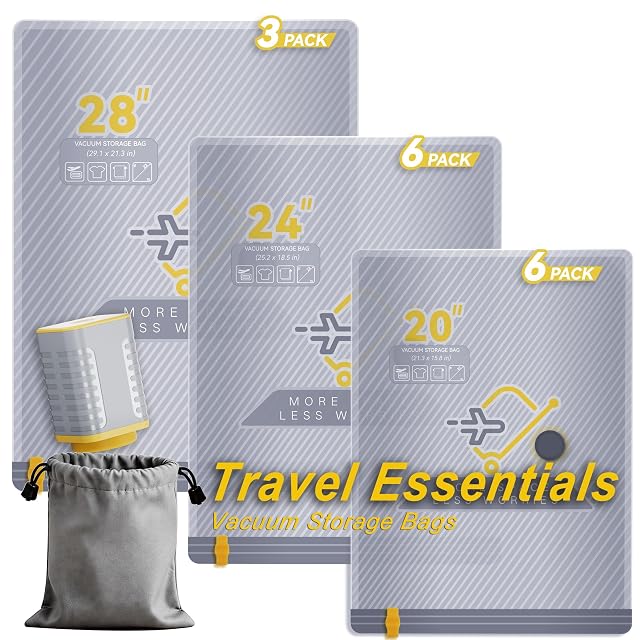
The rest of the specification is strong. The largest pump battery on the shelf at 2,400 mAh, over 120 uses per charge, a three-second seal, and all three bag sizes published in inches rather than as luggage sizes. A double-locking zipper as well as the valve, so there are two seals in series. PA+PE film stated against dust, moisture and punctures, and a drawstring pouch so the pump does not get separated from the bags between trips.
The arithmetic in the fourth bullet is the oddity. “Pack 2x More or Free Up 70% Space” — those are two different claims, and the second is bigger than the first. Take 70 per cent of the volume out of a pile of clothes and 30 per cent is left, so the same case holds more than three times as much. The listing has understated its own percentage, which is a rare direction for a product page to err in, and it is worth saying because on this shelf the compression claims run between 70 and 80 per cent for roll bags and pump bags alike, with one set giving no percentage at all.
What is missing is the pressure. A three-second seal describes how fast, 2,400 mAh describes how long, and neither describes how much air leaves — which is the suction figure, and only one brand on this shelf publishes it, at 4,000 and 6,000 pascals. Three of the fifteen bags are the large size, so the mix is weighted towards small and medium. And the mechanism costs you the pump: carried, charged, and still in the bag on the way home.
Availability
Read on the day this page was built: $30 at the American Amazon shop.
Read from Keepa on the day this page was last revised; stock and price both move without notice.
Prices quoted in this text were read on 2026-10-07. The live price is at the top of the page.
What travelers ask
Why does a three-month seal claim matter?
Because the third thing this hub compares is how the seal or valve holds up, and this is the only listing in either half that attaches a time to it. A vacuum bag that holds for a week is a packing aid; one that holds for three months is a storage product, which is what you want for a winter coat in a loft or a spare duvet under a bed. The figure is the maker's and nothing cites a method, but a number that can be falsified by the thing sitting flat or not sitting flat in June is a different kind of claim from "lasting airtight protection".
Two times more, or seventy per cent less?
They cannot both be right, and the bullet prints both. If a bag's contents are reduced by 70 per cent of their volume, what remains is 30 per cent — so the same case holds more than three times as much, not twice. "Pack 2x More" is the conservative reading of the maker's own percentage, which is an unusual direction for a listing to get something wrong in. Across this shelf the percentage claims run from 70 to 80 per cent on both mechanisms, and one set expresses itself only as "double your capacity" — so the units are inconsistent before the arithmetic is.
How does the pump compare?
It has the biggest battery here, 2,400 mAh, for over 120 uses and a three-second seal — all of which describe how long and how fast rather than how hard. The figure that describes how hard is the suction, and only one brand on this shelf publishes it, at 4,000 and 6,000 pascals for its two sets. A three-second seal on an unpublished suction and a ten-second seal on a published 6,000 Pa are not comparable claims, which is the gap on most of this shelf.