A wall plug built in — and the slower way to recharge it
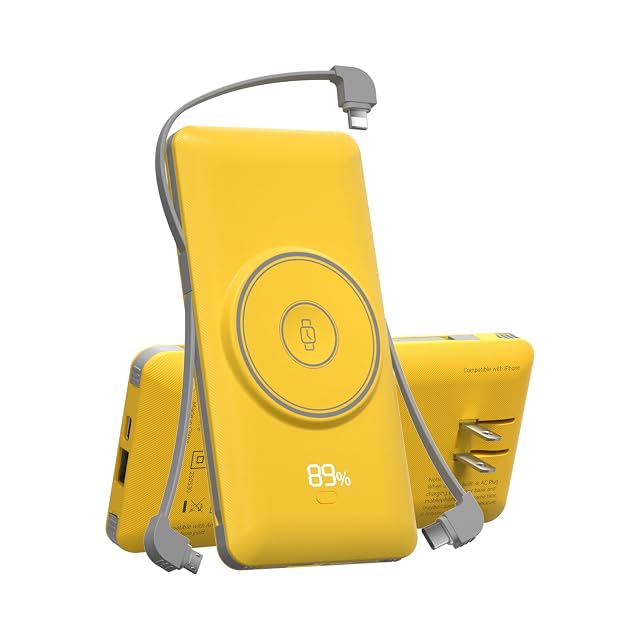
LUCKYFELLOW PB180W, 10000 mAh magnetic with AC plug
Six devices at once from a bank that plugs straight into a wall — on a listing whose very first bullet is a workaround for its own magnetic charging.
The strongest idea here is that the bank is also the charger. Mains prongs fold out of the body, so it recharges from any socket with nothing else packed — no brick, no cable, one fewer thing to forget. Around that there are five output routes and a wireless pad: three built-in cables, a USB-C port, a USB-A port and a magnetic pad rated to 15 W, with N52 magnets holding at a stated 1,500 grams. The capacity is translated device by device, 2.5 charges for an iPhone 17 Pro and 1.5 for a Pro Max, and the dimensions and weight are published, which half this shelf does not manage.
Two of its own numbers are worth putting side by side, because the page publishes both and says nothing about the comparison. From the built-in wall plug, a full recharge takes three to four hours. Over 20 W USB-C, it takes two and a half to three. The convenient route is the slow one, and knowing that is the difference between plugging it in before dinner and plugging it in before bed.
Then there is the first bullet, which is where this listing becomes unusual. Before any specification, before the magnets or the ports or the capacity, the page opens with an instruction: if your Apple Watch will not charge steadily on the magnetic pad, take the watch band off, because the raised connectors between watch and band hold the watch off the surface. That is genuinely useful and it is also a workaround for the product, placed first. The fourth bullet opens with “No exaggerated specs”. The two read better together than apart: this is a maker who knows where the product is awkward and has decided to say so early.
What is not published is the total. Six devices at once with no shared wattage means the per-device share is unknown — two banks on this shelf publish theirs, at 15 W over four devices and 87 W over three, and those numbers are precisely why the total matters. And like every listing in the American half of this hub, there is no watt-hour figure under the words “fully airline-compliant”; by the buying tip’s formula, 10,000 mAh at about 3.7 V is roughly 37 Wh. Our arithmetic, not the page’s.
Availability
Read on the day this page was built: $40 at the American Amazon shop.
Read from Keepa on the day this page was last revised; stock and price both move without notice.
Prices quoted in this text were read on 2026-10-07. The live price is at the top of the page.
What travelers ask
What does the first bullet tell you?
That magnetic watch charging on this bank is conditional. The opening bullet of the listing is an instruction: if the Apple Watch will not charge steadily, take the watch band off first, because the raised connectors between watch and band stop it lying flat on the pad. That is a real and useful piece of information, and it is also a workaround for the product occupying the first thing a buyer reads — on a page whose fourth bullet begins "No exaggerated specs". Read together, the two tell you the maker knows exactly where this product is awkward.
Is the built-in wall plug worth it?
It depends on what you are not packing. A bank with mains prongs recharges from any socket with nothing else in your bag, which is one plug, one cable and one brick fewer — and on a short trip that is the whole case for it. The page is honest enough to publish both times, and they are the other half of the story: three to four hours from the built-in plug, two and a half to three over 20 W USB-C. The convenient route is the slower one. There are also live mains prongs folded into something that lives loose in a bag, which is worth a moment's thought.
Can it really charge six things?
It has five output routes plus a wireless pad, which is six places to attach something, and the page never says how much power is shared between them. The wireless pad is rated to 15 W and the USB-C to 20 W; six devices at once has no published total. Two banks on this shelf do publish theirs — one at 15 W across four devices, one at 87 W across three — and those figures show how much the per-device share matters. Six ports with no total is a count of sockets rather than a charging claim.