87 W across three devices, 65 W to one — both published
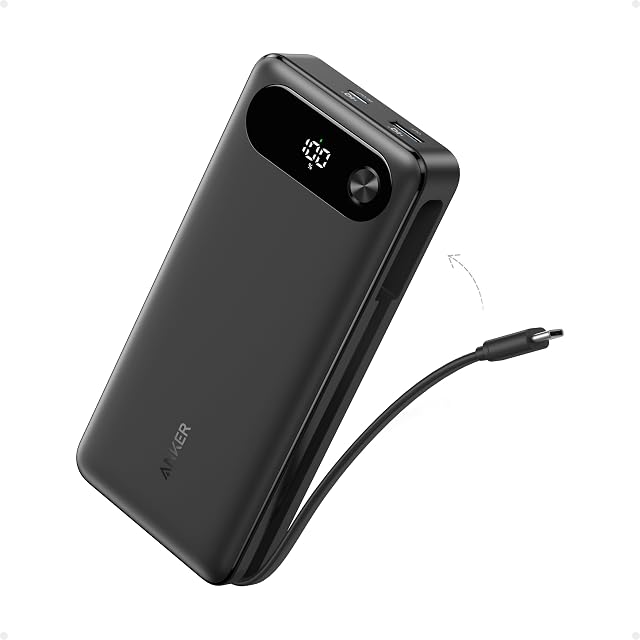
Anker A1383011, 20000 mAh 87 W
The only bank on this shelf above 10,000 mAh, the only one that charges a laptop properly, and the only one to publish both a shared total and a single-device maximum.
Everything else in the American half of this hub is a 10,000 mAh phone bank. This one is twice the capacity and nearly four times the output, and it is the only one on the shelf that will charge a laptop rather than merely slow its decline: 65 W to a single device, a 14-inch MacBook Pro to half charge in under forty minutes, and 87 W in total so a laptop at 65 W still leaves enough for two phones charging quickly beside it.
It is also the most completely specified page here. Both multi-device figures are published, the total and the single-device maximum — which is what two banks claiming six simultaneous devices and no total should be measured against. The recharge time comes with its condition attached: full in an hour and a half, with a 65 W charger. The built-in cable carries a durability figure, over 10,000 bends, which nothing else on this shelf offers for any component. The dimensions, the weight and the box contents are all listed.
Two caveats are real. The warranty is 18 months, which is the shortest term on this shelf, on the most expensive product on it — two makers here give three years at a third of the price. And the cable, for all its 10,000 bends, is built in: when it fails, the bank is finished, which is the argument one INIU on this shelf makes at length.
The last point is the one this hub exists to make. The bullet says the bank is “also approved for airline travel” and publishes no watt-hour rating — and at 20,000 mAh this is the bank on the shelf nearest the limit. Using the formula in this shelf’s buying tip, 20,000 mAh at about 3.7 V is roughly 74 Wh, comfortably inside the 100 Wh that most airlines permit without approval. That arithmetic is ours, done because no listing in the American half of this hub does it, and because 74 Wh is the number a security officer would ask for rather than 20,000 mAh.
Availability
Read on the day this page was built: $70 at the American Amazon shop.
Read from Keepa on the day this page was last revised; stock and price both move without notice.
Prices quoted in this text were read on 2026-10-07. The live price is at the top of the page.
What travelers ask
Is 20,000 mAh still allowed in a cabin?
By the arithmetic this shelf's buying tip sets out, yes, and with room to spare: 20,000 mAh at about 3.7 V is roughly 74 Wh, against the 100 Wh most airlines allow without prior approval. That calculation is ours. The page says only that the bank is "also approved for airline travel" — the conclusion, not the figure — which is worth noting because this is the bank on this shelf closest to the limit, and the one where a passenger is most likely to be asked. No listing in the American half of this hub publishes a watt-hour rating; the Anker Nano in the European half puts roughly 37 Wh in its specification line.
What does 87 W across three devices actually mean?
That the total is 87 W and no single device takes more than 65 W of it. Both halves are published here, which makes this the most complete multi-device claim on the shelf: a laptop at 65 W leaves 22 W for two phones, which is still fast charging for both. Compare it with the two banks here that advertise six devices and publish no total at all, or with the 10,000 mAh bank that honestly states 15 W shared across four — under four watts each. The number of ports is not the specification; the watts behind them are.
Is it worth the price over a 10,000 mAh bank?
If you charge a laptop, yes, and the gap is not close. Forty-five watts, which is the best any 10,000 mAh bank on this shelf offers, will keep a laptop alive; 65 W charges one, and a 14-inch MacBook Pro to half in under forty minutes is a different proposition from a slow trickle. You also get twice the capacity. What you pay is roughly three times the cheapest bank here, you carry nearly a pound, and you get the shortest warranty on the shelf at 18 months, against three years from two makers at a third of the price.