Percentage claims with their starting point stated
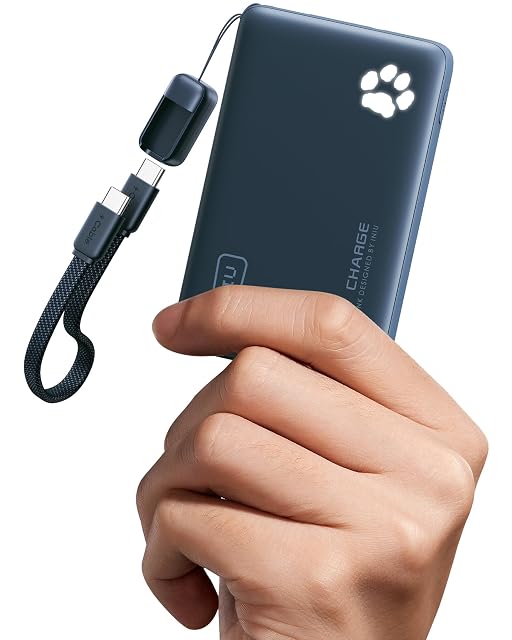
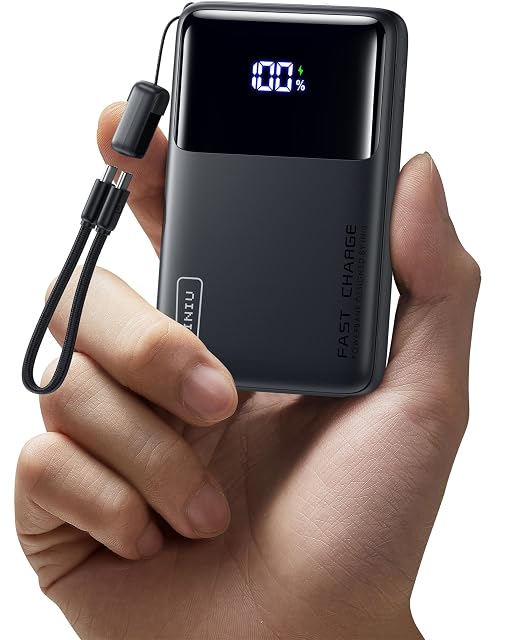
INIU BI-B41, 10000 mAh 45 W TinyCell
The only bank on this shelf whose charging claims state what charge they start from — and the one that argues hardest for a cable you can replace.
One clause makes this the most carefully written page on the shelf. Every charging claim here states the charge it starts from: an iPhone 17 Pro Max to 76 per cent, a Galaxy S25 Ultra to 84, an iPad Pro to 60, all in thirty minutes, all from 20 per cent. Batteries charge fastest when nearly empty and slow as they fill, so a percentage without a baseline is not a figure at all — and the other INIU bank on this shelf, same maker, same capacity, same 45 W, gives its claims with no starting point. That one clause is what separates a number you can plan around from one you cannot.
The second good decision is the cable. It detaches, and the listing says why: a built-in cord that breaks takes the whole bank with it, while a braided one you can swap keeps the bank alive. The counter-argument is on the page above this one, where another bank insists a permanently attached cable is one you cannot leave in a hotel. Both are right about their own failure, and the choice comes down to whether you lose cables or wear them out. If you keep a power bank for years — and the three-year cover here is the longest on this shelf — it is the second.
What the page will not tell you is how big it is. Forty per cent smaller and 36 per cent lighter than “conventional chargers”, with no dimension, no weight, and no conventional charger named. The dearer INIU below claims a far more modest 27 per cent and then publishes 4.4 by 2.7 by 0.7 in and 6.5 oz, which is the claim a buyer can actually use.
The regulatory figure is absent here as it is everywhere on this shelf. The bullet says “TSA-compliant, flight safe power bank” and never gives a watt-hour rating; by the formula in this shelf’s buying tip, 10,000 mAh at about 3.7 V is roughly 37 Wh, well inside the 100 Wh limit. That arithmetic is ours. Of the seven banks in the American half of this hub, none publishes the number and five assert the conclusion.
Availability
Read on the day this page was built: $22 at the American Amazon shop.
Read from Keepa on the day this page was last revised; stock and price both move without notice.
Prices quoted in this text were read on 2026-10-07. The live price is at the top of the page.
What travelers ask
Why does a starting charge matter in a percentage claim?
Because a battery charges fastest when it is nearly empty and slows down as it fills, so "to 76 per cent in 30 minutes" means nothing until you know where it began. This listing says from 20 per cent, for every one of its three claims — and it is the only page on this shelf to state the baseline. The INIU bank below it, from the same maker, gives the same kind of claim at the same wattage and does not say where it starts. That single clause is the difference between a number you can plan around and a number you cannot.
How small is 40 per cent smaller?
There is no way to tell from this page, and that is the gap in the headline. The bullet claims 40 per cent smaller and 36 per cent lighter than conventional chargers, and publishes no dimension and no weight to anchor either figure, and does not say which charger is conventional. The dearer INIU bank below it claims a more modest 27 per cent and then publishes 4.4 by 2.7 by 0.7 in and 6.5 oz. The smaller claim is the one you can check.
Is a 0.4 ft cable a problem?
It is a design decision rather than an oversight. Four tenths of a foot is about twelve centimeters, which is long enough to reach from the bank to a phone held against it and not long enough for anything else — so the pair travel as one block in a pocket, which is the point. What the page gets right is that the cable detaches: a cord flexed thousands of times is the part of a power bank that fails first, and here it can be swapped. The bank above it on this shelf argues the exact opposite, that a permanently attached cord is one you cannot leave behind.