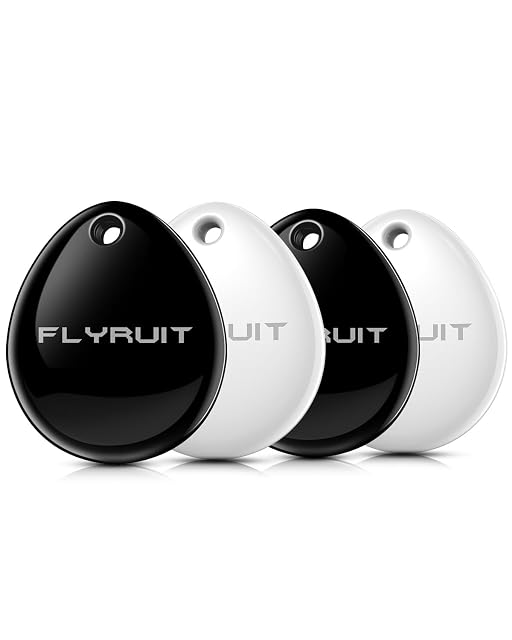
Four tags, a coin cell you can buy anywhere, and both figures published
FLYRUIT FTAG01B tracker tags, 4-pack
The cheapest tracker per unit on this shelf, on a replaceable coin cell, with the sound level, the range, the dimensions and the weight all published.
Four tags, a coin cell and a page that publishes its numbers. Per unit this is the cheapest tracking on the shelf by a distance — well under ten dollars a tag, against about twenty-four for each card in the other four-pack here — and it is the only Find My device in this hub running on a battery you can replace yourself. A CR2032 lasts a stated year, costs almost nothing, and is sold in every supermarket in the world, so a tag that dies abroad is fixed that afternoon. The rechargeable tags on this shelf last six to twelve months and need a wireless pad, which two of them admit is not supplied.
It also publishes the two figures that decide the end of a search. Eighty decibels, which is what you follow once the map has got you within a few meters and the bag is under a pile of coats, and 130 feet of Bluetooth range, which is how close you must be for the app to speak to the tag directly rather than through the network. Only one other device here publishes both, at 100 dB and 300 feet. The dimensions and the weight are given too, 1.44 by 1.22 by 0.34 in at 0.015 lb, and the battery level appears in the Find My app so the year is watched rather than assumed.
The small details are sensible. Two black and two white, so a household can assign them at a glance; a ring loop and a lanyard in the box; sharing with up to five people so a family can search together. The privacy paragraph is the clearest on the shelf: encrypted, anonymous, never stored on the tag, and an alert if an unknown tracker is traveling with you.
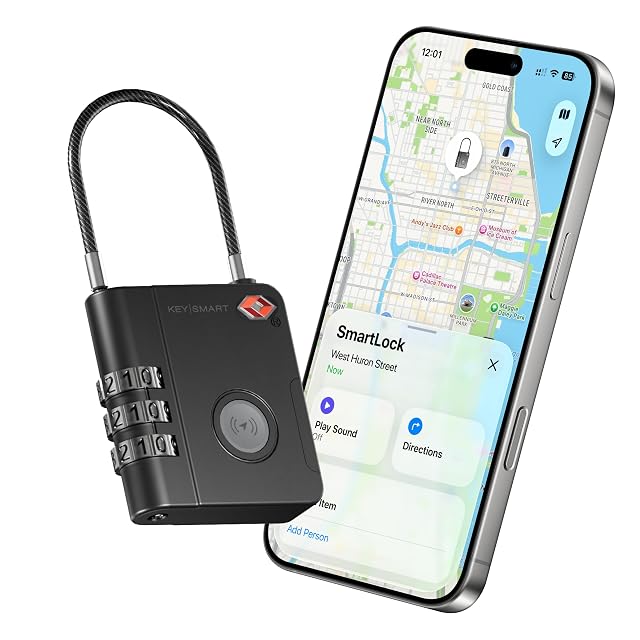
Its weakness is its shape. A tag on a loop is the external mount this shelf’s buying tip advises against, and nothing here resists a thumb the way the screw-lock strap at the top of this shelf does. There is no water or dust rating at all, where five devices here publish one. There is no contact card, so a finder has nothing to read. And like seven of the eight devices on this shelf, it needs an iPhone — the network is other people’s Apple devices, which is both why it works in an airport and why there is no Android version.
Availability
Read on the day this page was built: $30 at the American Amazon shop.
Read from Keepa on the day this page was last revised; stock and price both move without notice.
Prices quoted in this text were read on 2026-10-07. The live price is at the top of the page.
What travelers ask
Coin cell or rechargeable?
This is the only Find My device on this shelf with a user-replaceable coin cell, and there is a real argument for it. A CR2032 lasts a stated year, costs very little, and can be bought in any supermarket in any country — so a tag that goes flat on a trip is fixed that afternoon. The rechargeable tags here last six to twelve months and need a wireless charging pad, which two of them say explicitly is not in the box. The argument against is that a sealed battery cannot be left out after you change it, and that a loose coin cell is a hazard around small children.
Why does publishing 80 dB and 130 ft matter?
Because they are the two figures that decide whether you find a bag in the same building. The sound is what you follow when the map has put you within ten meters and the bag is under a pile of coats; the Bluetooth range is how close you have to be for the app to talk to the tag directly rather than through the network. Two devices on this shelf publish both — this one at 80 dB and 130 ft, the card four-pack at 100 dB and 300 ft. The other six publish neither, which makes them impossible to compare on the one thing that happens at the end of a search.
Four tags or one?
Four tags at this price work out at well under ten dollars each, which is less than any single tracker on this shelf and about a quarter of the per-unit price of the other four-pack here. The colors are the practical part rather than the decoration: two black and two white means a household can assign them without a spreadsheet, and the Find My app can be shared with up to five people so a family searches together rather than one person holding the phone.